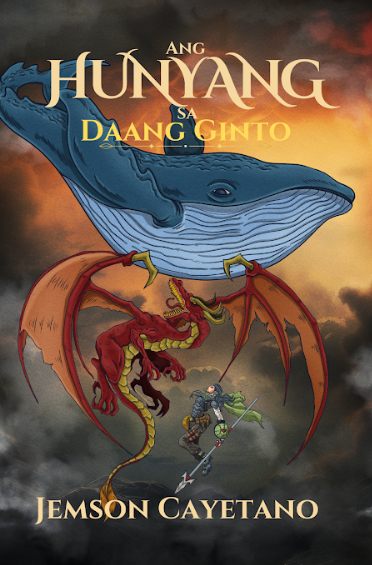
Ang Hunyáng sa Daang Ginto (roughly, The Hunyáng on the Golden Road) is an epic fantasy novel by Filipino author Jemson Cayetano. It is set in Mu, an original world inspired by Philippine and other Asian mythologies. Its hero, Ilaya, is a Hunyáng, a person who can transform into any creature they have killed. Ilaya refuses to kill. So the only form she can take is a pigeon.
That single idea carries the whole book, and it is why we wanted to talk to the person who wrote it.
Excapelabs started as a home for the Philippine indie music scene. But our tagline is Unorthodox Mind, and that kind of mind is not limited to musicians. As we open our doors to creatives beyond music, Jemson’s book felt like the right story to tell.
What is Ang Hunyáng sa Daang Ginto about?
Ang Hunyáng sa Daang Ginto follows Ilaya, a young woman from Sanlipi, a nation the rest of her world tends to overlook. She is the first Hunyáng born among her people in a long time. Her mission takes her to the far-off kingdom of Hian, where she must face many stronger Hunyángs to win a single Hiling (Tagalog for wish) that could save her homeland.
The obstacle is built into the premise. Every other Hunyáng can add a new form with each creature they kill. Ilaya, by choice, has only one.
Jemson says that at its heart, the book is about “what it means to be strong without being powerful.” It also looks at what happens when a world’s systems are built on violence and one person refuses to take part.
Who is Jemson Cayetano?
Jemson Cayetano is a Filipino author and the writer of Ang Hunyáng sa Daang Ginto, the first book of a planned trilogy. Writing an epic fantasy novel had always been his dream, and he says he was simply waiting for the right idea to arrive. He is now writing the second installment.
He calls himself a student of Pinoy comedy (Pinoy is the informal word Filipinos use for themselves). He also points to The Lord of the Rings and One Piece as proof that worldbuilding is what makes a story timeless.
Where did the idea for the book come from?
The idea came from one question. While watching an anime, Jemson wondered what would happen if a power usually given to villains belonged to the main character instead, or became the main power system of an entire world.
He settled on shapeshifting, a classic trickster ability tied to characters like Loki and Mystique. From there, he started working out how it could become an intricate power system with its own rules.
Jemson is open about the fact that the idea “didn’t start very deep.” What gives it weight is the rule attached to it. A Hunyáng gains a new form only by killing the creature first. That one rule turns a familiar villain trick into a moral problem, and it gives Ilaya the choice that defines her.
What does the word Hunyáng mean?
Hunyáng is a word Jemson invented. He built it from hunyango, the Tagalog word for chameleon, an animal people often link with shapeshifting and adaptation. Some readers assume the word comes from existing mythology, which says a lot about how naturally it fits the world of Mu.
The word is more than a label for the hero. Jemson says it “represents the whole point of the story.” The book shows how the Hunyángs shape the reality of their world, and what happens when one of them refuses to gain power the way the others do.
What questions does the book ask its readers?
Jemson does not write to deliver a lesson. “I am not one to preach about values and ideals,” he says. What he wants is for readers to sit with the same questions he asks himself.
Two of those questions run through the book: “How far can one go in pursuit of ambition or principles? How can we say it is okay to be ourselves if we are already bringing harm to others?”
Ilaya’s refusal to kill puts both questions under pressure. Her principle keeps her small in a world built on violence, and her mission forces her to face Hunyángs far more powerful than she is. Jemson admits the book may not offer an answer that satisfies everyone. For him, getting a reader to ask the question at all is “more than worth the effort.”
Which character means the most to him?
Jemson loves his whole cast, especially the main group of Ilaya, Lam-Ang, Hendra, and Pei-Pei. But the character he singles out sits outside that group.
Her name is Elda, and she is a side character. Jemson says he wrote her very carefully, and he describes her arc as “a beautifully haunting story” that still gives him chills.
Elda did more than move him. She changed the book. Jemson adjusted the tone of the whole story to make sure he did her justice. That is a big change to make for someone outside the main cast. He hopes readers will love her story as much as he does.
How did he build the world of Mu?
Jemson calls building Mu the hardest part of writing the book. He wanted a world that feels alive, cohesive, and consistent.
He holds a firm view on this, even knowing some authors may disagree. He believes epic fantasy asks a writer to commit 100% to a believable world. His reference points are The Lord of the Rings and One Piece, two stories he sees as timeless because of their worldbuilding.
Mu draws on Philippine and other Asian mythologies, but Jemson stresses that it is entirely original. It holds places like Sanlipi, Ilaya’s overlooked homeland, and Hian, the far-off kingdom where her mission leads. The Hunyáng power system gives the world its rules: who can become what, and at what cost.
For readers who know fantasy through Middle-earth or the Grand Line, Mu is built with that same ambition, drawn from Philippine and Asian myth.
Where does the humor come from?
An epic about violence and principle might sound heavy. Jemson balances it with humor.
He says a writer’s observations shape the work more than most writers realize, from style and themes down to specific scenes. Comedy is his clearest example. As a self-proclaimed student of Pinoy comedy, he enjoyed writing funny scenes that Filipino readers will recognize from their daily lives, even though the story takes place in a different world and time period.
For readers outside the Philippines, those scenes offer a look at everyday Filipino humor. For Filipino readers, they are the moments that make Mu feel close to home. The jokes sit beside the book’s heavier moments, and some readers have told Jemson they felt all kinds of emotions throughout the book and loved it for that.
What was the road to readers like?
Jemson describes his journey with the book as a roller coaster. He calls it the one story where he can honestly say he “spent all the creativity within my body.” So when it went unsold on several occasions, it hurt.
He knew it would not be easy. What kept him going was readers. People came to him to say how much they enjoyed the book, and for him, that was enough.
Now that more people have discovered Hunyáng, Jemson says he “really can’t ask for more.” He is happy, motivated, and already writing the second installment of the trilogy.
His experience will sound familiar to independent creators anywhere, in books or in music. The work often comes long before the audience does, and the people who show up early are the ones who keep it alive.
What does he want readers to remember?
At the very least, Jemson wants readers to feel they have been part of a wonderful journey with the characters. He wants them to smile, cry, and even get annoyed when a character does something annoying.
If they remember only one thing, he points to a mantra he always uses when he writes dedications:
“Hindi man palaging ginto ang daang ating nilalakaran, ‘wag natin kalilimutan na ang pagiging mabuti ang pinakamagandang anyo.”
In English, it reads roughly: even if the road we walk is not always golden, let us not forget that being good is the most beautiful form.
The line echoes the golden road in the book’s title. It also uses the word anyo, meaning form, the same idea the Hunyáng power is built on. Of all the forms a Hunyáng can take, being good is the one Jemson most wants readers to keep.
Where can you get Ang Hunyáng sa Daang Ginto?

Print copies are sold on Lazada and Shopee in the Philippines, and there is also an ebook edition, which may be the easiest option for readers outside the Philippines. Jemson also takes pre-orders for signed copies. Every link is on his official Linktree, along with his Goodreads page for anyone who wants to leave a review.
In the doc, “ebook edition” links to https://eightlettersbooks.gumroad.com/l/orogce and “his official Linktree” links to https://linktr.ee/Hunyang.Ilaya.
A Note From Excapelabs
If you are a creative outside music with a story to tell, our doors are open.
Leave a Reply